Receiving the Outstanding Presentation Paper Award again at SAREK Summer Conference 2026

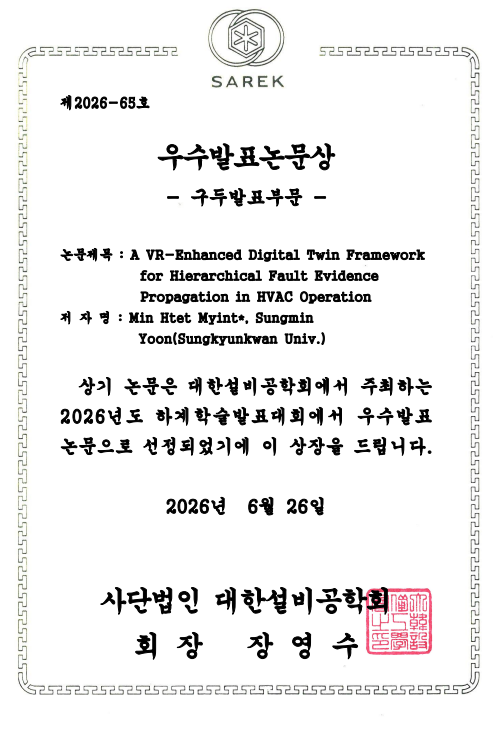
Receiving the Outstanding Presentation Paper Award (우수발표논문상) at the 2026 Summer Conference of the Society of Air-Conditioning and Refrigerating Engineers of Korea (SAREK) was a very meaningful milestone in my Ph.D. journey.
What made this experience especially memorable was that it was also my very first conference presentation delivered entirely in Korean. As an international Ph.D. student at Sungkyunkwan University, presenting technical research in Korean was both exciting and challenging. Beyond the research itself, this moment felt like recognition of my effort to improve professional communication and actively participate in the Korean academic community.
Interestingly, this was also my second consecutive conference presentation award. Last semester, I presented my research in English and received the Best Presenter Award. This semester, I challenged myself to present fully in Korean and was honored to receive another presentation award again. Looking back, it feels rewarding to see both my research journey and communication skills gradually improving together.

Presented Research
“A VR-Enhanced Digital Twin Framework for Hierarchical Fault Evidence Propagation in HVAC Operation”
The research introduces a VR-enhanced digital twin framework called STEP (Spatio-Temporal Evidence Propagation) for HVAC operation and maintenance.
The main goal of the framework is to help operators interpret HVAC faults more intuitively by combining:
Building operational data
FDD (Fault Detection and Diagnosis) outputs
BIM–MEP semantic relationships
Temporal evidence smoothing
Immersive VR visualization
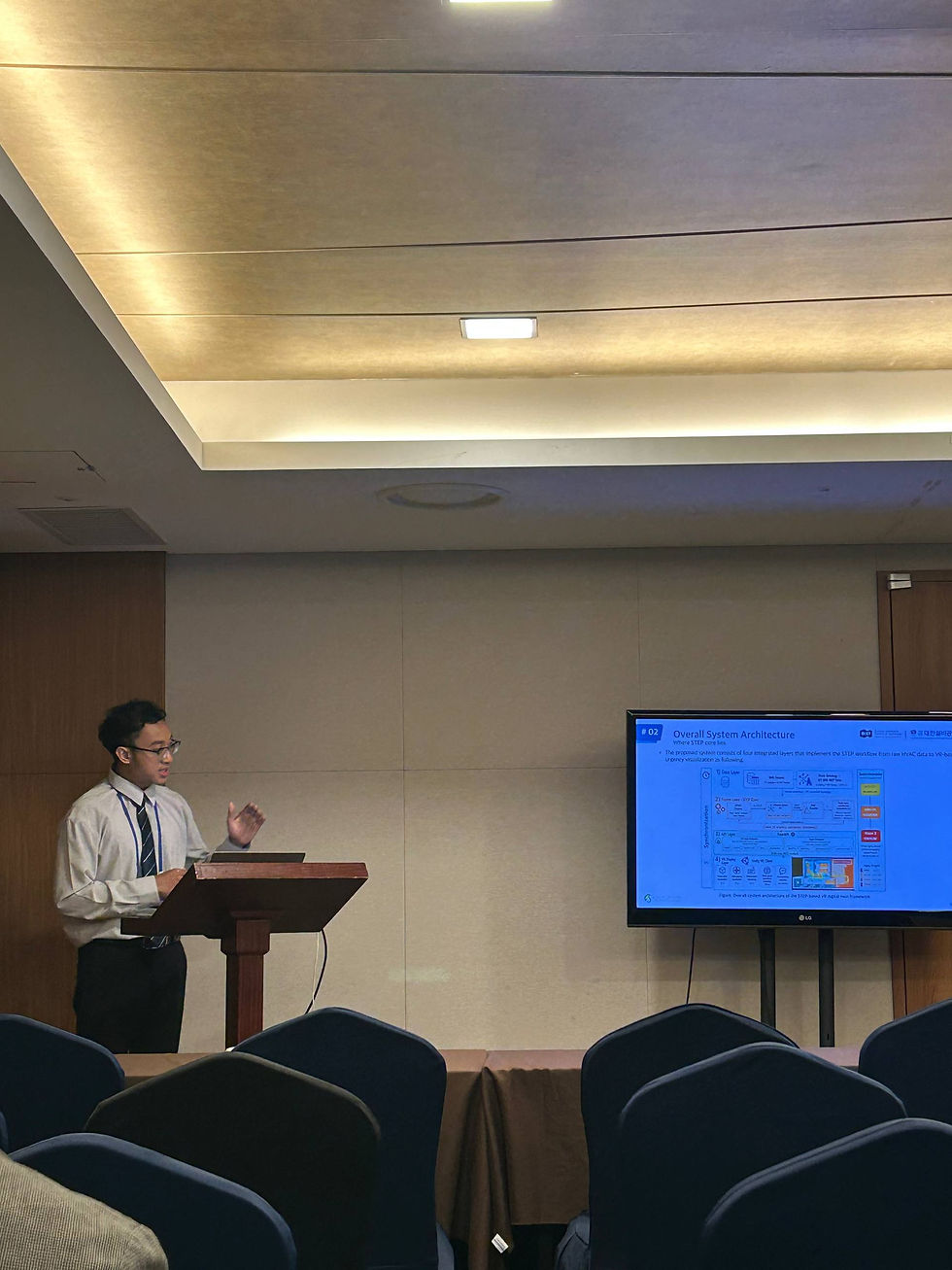
Instead of viewing disconnected 2D dashboards, operators can observe how faults propagate spatially from rooms to connected VAV and AHU systems inside a VR-based digital twin environment.
The framework was implemented using:
Unity-based VR visualization
BIM-integrated HVAC semantic structures
Real BMS operational datasets
AI-assisted diagnostic synchronization
Near real-time API communication
Why This Research Matters
Modern HVAC systems generate large amounts of operational data, but interpreting faults in spatial context remains difficult. This work explores how immersive VR environments and digital twins can support more spatially grounded understanding of building systems and maintenance workflows.
Rather than focusing only on automation, the research emphasizes:
interpretation support,
spatial traceability,
and intuitive fault visualization for operators.
A Meaningful Personal Milestone
Looking back, I still remember feeling nervous before starting the presentation in Korean. Preparing technical explanations, practicing terminology, and answering questions in another language was a challenge, but also a rewarding experience.
Receiving this award encourages me to continue pursuing interdisciplinary research combining:
AI
BIM
VR/XR
Digital Twins
Smart Building Systems
I am sincerely grateful to my advisor, lab members, conference organizers, and everyone who supported and encouraged me throughout this journey.

Moving Forward
This experience motivates me to continue exploring immersive and spatially grounded AI systems for smart building operation and facility management.
More exciting research ahead 🚀
#HVAC #DigitalTwin #VirtualReality #BIM #AI #SmartBuildings #FacilityManagement #SAREK #Unity3D #XR #PhDLife


Comments